
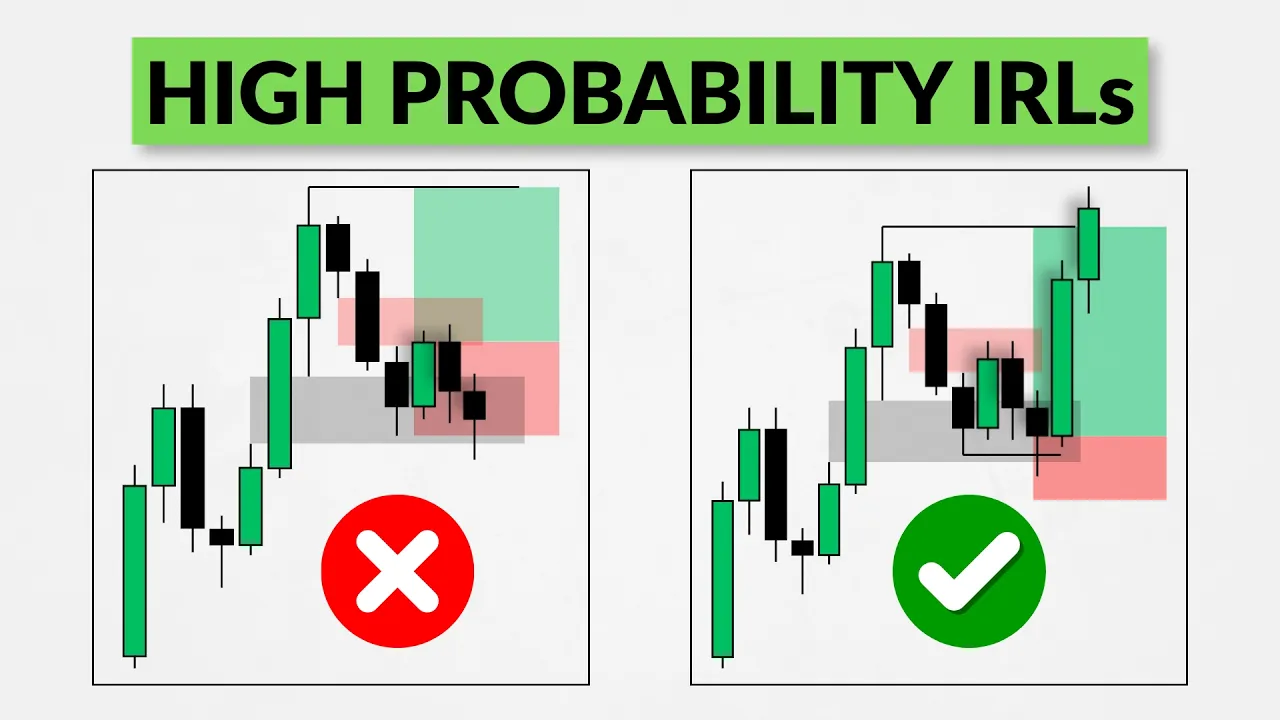
High Probability IRL
High Probability IRL
How to Identify Quality IRL Setups and Avoid Low-Probability Trades
How to Identify Quality IRL Setups and Avoid Low-Probability Trades

Introduction
High-probability Internal Range Liquidity is important if you want to identify quality trading opportunities.
When you look at a chart, you will notice that there are many Internal Range Liquidity (IRL) areas. However, this doesn't mean you can take a trade from every single one of them.
You need to understand what makes an Internal Range Liquidity high probability and what makes one low probability. In this article, we will break down the key things to look out for when identifying quality IRL setups.
Two Ways to Identify High-Probability IRL
1. Check for Unmitigated Opposing Fair Value Gaps
One of the first things to check when identifying a high-probability Internal Range Liquidity is whether there is an unmitigated opposing Fair Value Gap (FVG) within the retracement leading back into your IRL.
Why does this matter?
An unmitigated opposing Fair Value Gap can act as a potential roadblock to price. If price is retracing toward a bullish IRL but encounters an unmitigated bearish Fair Value Gap along the way, that gap may resist the upward movement. The same applies to a bearish IRL when an unmitigated bullish Fair Value Gap lies within the retracement.
This reduces the quality of the setup because price may react to the opposing imbalance before reaching your intended area or struggle to continue in your expected direction.
On the other hand, when there is no unmitigated opposing Fair Value Gap obstructing the retracement into your Internal Range Liquidity, the setup may offer a clearer path for price to reach the area and react as anticipated.

This is one factor to consider when assessing the quality of an IRL. Remember, an opposing Fair Value Gap doesn't always stop price, and its presence or absence alone doesn't guarantee the outcome of a trade.
How to Trade IRL When an Opposing Fair Value Gap Is Present
When price retraces into your Internal Range Liquidity and creates an opposing Fair Value Gap, it doesn't automatically mean you should abandon the setup. There are two ways you can approach this situation.
Wait for the Opposing FVG to Complete Its IRL → ERL Cycle
The first approach is to wait for price to complete the Internal Range Liquidity to External Range Liquidity cycle of the opposing Fair Value Gap while price is still within your original Internal Range Liquidity.
For example, let's say you have a bullish Internal Range Liquidity and price retraces into it. During that retracement, price creates a bearish Fair Value Gap, which acts as an opposing imbalance.
Rather than entering immediately, you can wait for price to move from the opposing Fair Value Gap's internal range toward its external range, completing its cycle while remaining within your original bullish IRL.
Once this happens, you can drop to a lower timeframe and look for an entry confirmation in the direction of your original bias. Your target would be the relevant External Range Liquidity.

Wait for Price to Disrespect the Opposing FVG and Form a New IRL
The second approach is to wait for price to completely disrespect the opposing Fair Value Gap and then form a new Internal Range Liquidity.
In this situation, you don't want to enter immediately just because price has moved through the opposing FVG. Instead, wait for price to establish a new IRL after the opposing imbalance has been invalidated.
Once the new Internal Range Liquidity forms, you can wait for price to retrace into that area and look for a suitable entry confirmation.
If the setup aligns with your original market bias, you can then look to take a trade targeting the relevant External Range Liquidity.
The important thing here is patience. Price breaking through an opposing Fair Value Gap is not an entry signal on its own. You still want to see a new Internal Range Liquidity form before considering a trade.

2. Make Sure Price Has Not Completed Its IRL → ERL Cycle
The second thing you need to check when identifying a high-probability Internal Range Liquidity is whether price has already completed its IRL → ERL cycle.
Remember, when price leaves an Internal Range Liquidity, we anticipate that it will move toward its corresponding External Range Liquidity. Once that External Range Liquidity has been taken, the cycle is complete, and the original Internal Range Liquidity will generally carry less weight as a fresh trading opportunity.
For example, let's say price enters a bullish Internal Range Liquidity and pushes upward but fails to take out its corresponding External Range Liquidity. Price then returns to the same Internal Range Liquidity.
In this situation, the cycle has not yet been completed because the External Range Liquidity remains intact. Therefore, the original IRL is still relevant.

However, once price pushes upward and takes out the corresponding External Range Liquidity, the cycle is complete. At that point, you should avoid treating the original Internal Range Liquidity as though it were still a fresh setup.

What Happens After the Cycle Is Completed?
Once price has completed its IRL → ERL cycle, you can look for a new Internal Range Liquidity to form.
If price leaves a new IRL, you can treat that area as your new Point of Interest (POI). From there, you can drop to a lower timeframe and look for an entry confirmation when price returns to that area.
This allows you to work with a fresh Internal Range Liquidity rather than continuing to rely on one whose corresponding External Range Liquidity has already been taken.

Final Thoughts
Identifying high-probability Internal Range Liquidity is not just about finding a Fair Value Gap. You also need to understand the condition of the IRL, the presence of opposing Fair Value Gaps, and whether the corresponding IRL → ERL cycle is still incomplete.
Always check these two factors before looking for an entry. They can help you filter out weaker setups and focus on Internal Range Liquidity areas that better align with your trading model.
Remember, no setup is guaranteed to work. Use these conditions alongside your market bias, entry confirmation, and risk management to make more informed trading decisions.
Watch Youtube Video
Introduction
High-probability Internal Range Liquidity is important if you want to identify quality trading opportunities.
When you look at a chart, you will notice that there are many Internal Range Liquidity (IRL) areas. However, this doesn't mean you can take a trade from every single one of them.
You need to understand what makes an Internal Range Liquidity high probability and what makes one low probability. In this article, we will break down the key things to look out for when identifying quality IRL setups.
Two Ways to Identify High-Probability IRL
1. Check for Unmitigated Opposing Fair Value Gaps
One of the first things to check when identifying a high-probability Internal Range Liquidity is whether there is an unmitigated opposing Fair Value Gap (FVG) within the retracement leading back into your IRL.
Why does this matter?
An unmitigated opposing Fair Value Gap can act as a potential roadblock to price. If price is retracing toward a bullish IRL but encounters an unmitigated bearish Fair Value Gap along the way, that gap may resist the upward movement. The same applies to a bearish IRL when an unmitigated bullish Fair Value Gap lies within the retracement.
This reduces the quality of the setup because price may react to the opposing imbalance before reaching your intended area or struggle to continue in your expected direction.
On the other hand, when there is no unmitigated opposing Fair Value Gap obstructing the retracement into your Internal Range Liquidity, the setup may offer a clearer path for price to reach the area and react as anticipated.
This is one factor to consider when assessing the quality of an IRL. Remember, an opposing Fair Value Gap doesn't always stop price, and its presence or absence alone doesn't guarantee the outcome of a trade.
How to Trade IRL When an Opposing Fair Value Gap Is Present
When price retraces into your Internal Range Liquidity and creates an opposing Fair Value Gap, it doesn't automatically mean you should abandon the setup. There are two ways you can approach this situation.
Wait for the Opposing FVG to Complete Its IRL → ERL Cycle
The first approach is to wait for price to complete the Internal Range Liquidity to External Range Liquidity cycle of the opposing Fair Value Gap while price is still within your original Internal Range Liquidity.
For example, let's say you have a bullish Internal Range Liquidity and price retraces into it. During that retracement, price creates a bearish Fair Value Gap, which acts as an opposing imbalance.
Rather than entering immediately, you can wait for price to move from the opposing Fair Value Gap's internal range toward its external range, completing its cycle while remaining within your original bullish IRL.
Once this happens, you can drop to a lower timeframe and look for an entry confirmation in the direction of your original bias. Your target would be the relevant External Range Liquidity.
Wait for Price to Disrespect the Opposing FVG and Form a New IRL
The second approach is to wait for price to completely disrespect the opposing Fair Value Gap and then form a new Internal Range Liquidity.
In this situation, you don't want to enter immediately just because price has moved through the opposing FVG. Instead, wait for price to establish a new IRL after the opposing imbalance has been invalidated.
Once the new Internal Range Liquidity forms, you can wait for price to retrace into that area and look for a suitable entry confirmation.
If the setup aligns with your original market bias, you can then look to take a trade targeting the relevant External Range Liquidity.
The important thing here is patience. Price breaking through an opposing Fair Value Gap is not an entry signal on its own. You still want to see a new Internal Range Liquidity form before considering a trade.
2. Make Sure Price Has Not Completed Its IRL → ERL Cycle
The second thing you need to check when identifying a high-probability Internal Range Liquidity is whether price has already completed its IRL → ERL cycle.
Remember, when price leaves an Internal Range Liquidity, we anticipate that it will move toward its corresponding External Range Liquidity. Once that External Range Liquidity has been taken, the cycle is complete, and the original Internal Range Liquidity will generally carry less weight as a fresh trading opportunity.
For example, let's say price enters a bullish Internal Range Liquidity and pushes upward but fails to take out its corresponding External Range Liquidity. Price then returns to the same Internal Range Liquidity.
In this situation, the cycle has not yet been completed because the External Range Liquidity remains intact. Therefore, the original IRL is still relevant.
However, once price pushes upward and takes out the corresponding External Range Liquidity, the cycle is complete. At that point, you should avoid treating the original Internal Range Liquidity as though it were still a fresh setup.
What Happens After the Cycle Is Completed?
Once price has completed its IRL → ERL cycle, you can look for a new Internal Range Liquidity to form.
If price leaves a new IRL, you can treat that area as your new Point of Interest (POI). From there, you can drop to a lower timeframe and look for an entry confirmation when price returns to that area.
This allows you to work with a fresh Internal Range Liquidity rather than continuing to rely on one whose corresponding External Range Liquidity has already been taken.
Final Thoughts
Identifying high-probability Internal Range Liquidity is not just about finding a Fair Value Gap. You also need to understand the condition of the IRL, the presence of opposing Fair Value Gaps, and whether the corresponding IRL → ERL cycle is still incomplete.
Always check these two factors before looking for an entry. They can help you filter out weaker setups and focus on Internal Range Liquidity areas that better align with your trading model.
Remember, no setup is guaranteed to work. Use these conditions alongside your market bias, entry confirmation, and risk management to make more informed trading decisions.
Watch Youtube Video


Read all
PREVIOUS
Introduction to Internal and External Liquidity
PREVIOUS
Introduction to Internal and External Liquidity
NEXT
Read all

Free market insights and exclusive updates, straight to your inbox.
No spam. We hate it as much as you do.
Copyright © 2025 ChartTactix. All rights reserved.
Free market insights and exclusive updates, straight to your inbox.
No spam. We hate it as much as you do.
Copyright © 2025 ChartTactix. All rights reserved.
Copyright © 2025 ChartTactix. All rights reserved.
Market insights and exclusive updates.
No spam. We hate it as much as you do.
Copyright © 2025 ChartTactix. All rights reserved.
Market insights and exclusive updates.
No spam. We hate it as much as you do.