
ICT Power of Three
ICT Power of Three
Accumulation → Manipulation → Distribution
Accumulation → Manipulation → Distribution

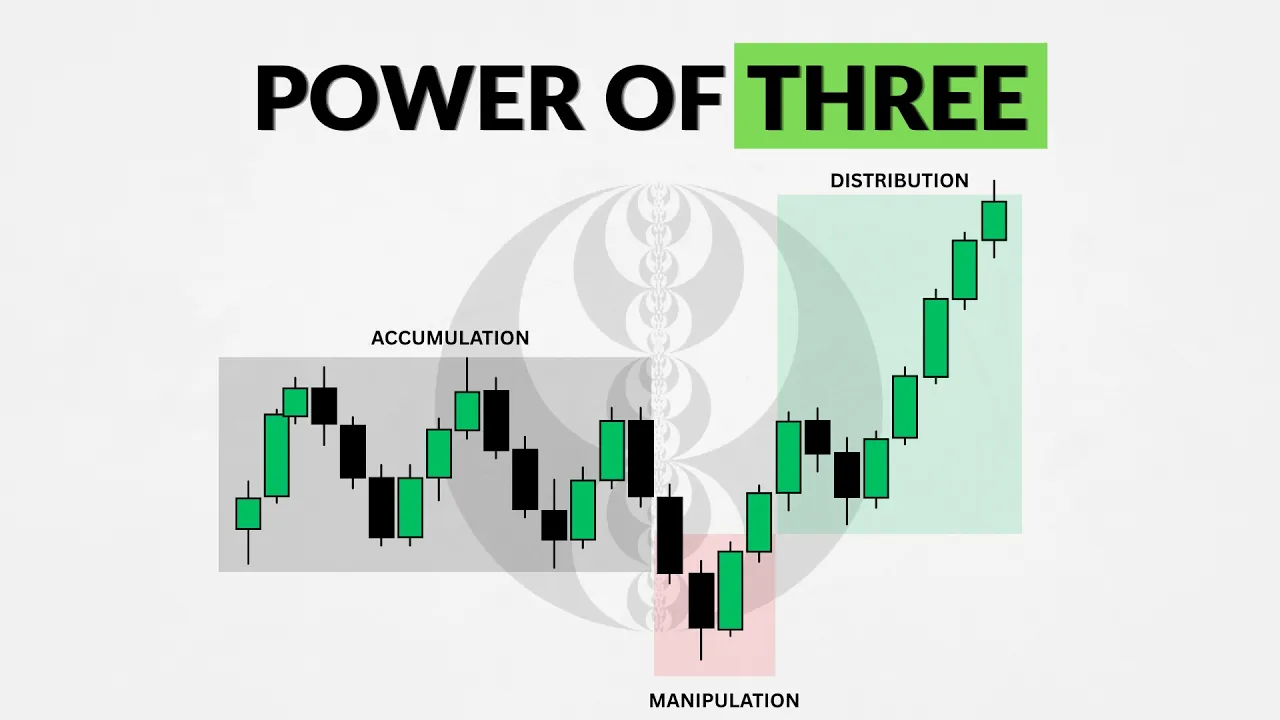
The Power of Three, also known as AMD (Accumulation, Manipulation, Distribution), is a three-phase concept used to understand how price can develop around a range before making its larger directional move.
The three phases are Accumulation, Manipulation, and Distribution. Understanding these phases can help you recognize when the market is consolidating, when it is taking liquidity in the opposite direction, and when it begins its actual expansion.
Accumulation
The first phase is Accumulation.
This is where price begins moving sideways or consolidating within a relatively defined range. During this phase, the market is essentially building liquidity on both sides of the range as buyers and sellers continue to interact without a clear directional expansion.
You will often see price repeatedly move between a high and a low, creating an area where liquidity begins to build.

Manipulation
The second phase is Manipulation.
This is where price breaks out of the established range and makes a move in one direction, often giving the appearance that the market is about to continue in that direction.
This move can trap traders who enter immediately after the breakout, believing that price is beginning a genuine expansion.
For example, price may accumulate within a range and then suddenly break below the range low. Traders may interpret this as a bearish breakout and enter short positions. However, instead of continuing lower, price can reverse back into the range.
This is the manipulation phase.

Distribution
The final phase is Distribution.
After the manipulation takes place, price can reverse impulsively and begin expanding in the opposite direction. This is where the market moves away from the accumulation range and begins its larger directional move.
Using the previous example, price breaks below the range, traps traders on the short side, and then aggressively reverses higher. The subsequent move higher represents the distribution phase.
The important thing to understand is that the manipulation and distribution phases are what give the Power of Three its usefulness. Instead of viewing a breakout in isolation, you begin to consider what happened before the breakout and what price does immediately afterward.

The Power of Three therefore gives us a simple framework for understanding the relationship between consolidation, liquidity manipulation, and directional expansion.
However, AMD should not be treated as a rigid pattern that must appear exactly the same way every time. The three phases can develop differently depending on the timeframe and market conditions.
The Power of Three in a Daily Candle
One of the simplest ways to understand the Power of Three is by looking at how it can develop inside a single daily candle.
A daily candle consists of four important components: the open, high, low, and close.
In a bullish scenario, price can open and initially consolidate around the opening price before moving lower. That move lower creates the low of the day and represents the manipulation phase.
After taking liquidity below the opening range, price can then reverse and move aggressively higher. This expansion creates the high of the day, and price eventually closes higher, producing a bullish daily candle.
In simple terms:
Open → Accumulation → Manipulation Lower → Expansion Higher → Close

The same concept can appear in a bearish daily candle.
Price opens and initially consolidates before pushing higher. This move creates the high of the day and represents the manipulation phase.
Price then reverses aggressively and begins expanding lower, creating the low of the day before eventually closing lower.
In simple terms:
Open → Accumulation → Manipulation Higher → Expansion Lower → Close

This is one reason the Power of Three is useful when studying daily price action. What appears to be a simple bullish or bearish candle can sometimes be broken down into smaller phases of accumulation, manipulation, and distribution.
The Power of Three Across Trading Sessions
The same idea can also be applied to the intraday session.
A common way to visualize this is through the relationship between the Asian, London, and New York sessions.
For a bullish day, the Asian session may provide the accumulation phase as price consolidates within a relatively narrow range.
The London session may then create the manipulation by pushing price below the Asian range and taking liquidity from the lows.
If that sell-side liquidity sweep is followed by a strong reversal, the New York session may then provide the expansion or distribution phase, with price moving higher.

The bearish scenario can develop in the opposite way.
Price may accumulate during the Asian session, creating a range and building liquidity around its highs and lows. During the London session, price may push above the range and take buy-side liquidity, creating the manipulation.
Price can then reverse and expand lower during the New York session, producing the distribution phase.

The reason the Asian session is often associated with accumulation is that it can experience lower trading activity and narrower price ranges compared with the major London and New York trading periods. This can allow price to consolidate and establish a range before increased activity later in the day.
When an Asian range forms clearly, traders can then pay attention to how London interacts with the range. A sweep of the Asian high or low followed by a strong reversal can provide the manipulation component of the Power of Three, while the subsequent expansion can provide the distribution.
However, this does not happen every day.
The Asian session does not have to accumulate, London does not always have to manipulate, and New York does not always have to provide the distribution. Market conditions, volatility, news, and the broader higher-timeframe context can all influence how price behaves.
The Power of Three is therefore better understood as a framework for interpreting price delivery, rather than a formula that guarantees a particular sequence across every trading session.
When you begin to look at price through this framework, you stop seeing every breakout as a potential continuation and start asking a more important question:
Is this actually the beginning of the move, or is the market first taking liquidity before making its real expansion?
That is the essence of the Power of Three.
Watch Full Video on Youtube
The Power of Three, also known as AMD (Accumulation, Manipulation, Distribution), is a three-phase concept used to understand how price can develop around a range before making its larger directional move.
The three phases are Accumulation, Manipulation, and Distribution. Understanding these phases can help you recognize when the market is consolidating, when it is taking liquidity in the opposite direction, and when it begins its actual expansion.
Accumulation
The first phase is Accumulation.
This is where price begins moving sideways or consolidating within a relatively defined range. During this phase, the market is essentially building liquidity on both sides of the range as buyers and sellers continue to interact without a clear directional expansion.
You will often see price repeatedly move between a high and a low, creating an area where liquidity begins to build.
Manipulation
The second phase is Manipulation.
This is where price breaks out of the established range and makes a move in one direction, often giving the appearance that the market is about to continue in that direction.
This move can trap traders who enter immediately after the breakout, believing that price is beginning a genuine expansion.
For example, price may accumulate within a range and then suddenly break below the range low. Traders may interpret this as a bearish breakout and enter short positions. However, instead of continuing lower, price can reverse back into the range.
This is the manipulation phase.
Distribution
The final phase is Distribution.
After the manipulation takes place, price can reverse impulsively and begin expanding in the opposite direction. This is where the market moves away from the accumulation range and begins its larger directional move.
Using the previous example, price breaks below the range, traps traders on the short side, and then aggressively reverses higher. The subsequent move higher represents the distribution phase.
The important thing to understand is that the manipulation and distribution phases are what give the Power of Three its usefulness. Instead of viewing a breakout in isolation, you begin to consider what happened before the breakout and what price does immediately afterward.
The Power of Three therefore gives us a simple framework for understanding the relationship between consolidation, liquidity manipulation, and directional expansion.
However, AMD should not be treated as a rigid pattern that must appear exactly the same way every time. The three phases can develop differently depending on the timeframe and market conditions.
The Power of Three in a Daily Candle
One of the simplest ways to understand the Power of Three is by looking at how it can develop inside a single daily candle.
A daily candle consists of four important components: the open, high, low, and close.
In a bullish scenario, price can open and initially consolidate around the opening price before moving lower. That move lower creates the low of the day and represents the manipulation phase.
After taking liquidity below the opening range, price can then reverse and move aggressively higher. This expansion creates the high of the day, and price eventually closes higher, producing a bullish daily candle.
In simple terms:
Open → Accumulation → Manipulation Lower → Expansion Higher → Close
The same concept can appear in a bearish daily candle.
Price opens and initially consolidates before pushing higher. This move creates the high of the day and represents the manipulation phase.
Price then reverses aggressively and begins expanding lower, creating the low of the day before eventually closing lower.
In simple terms:
Open → Accumulation → Manipulation Higher → Expansion Lower → Close
This is one reason the Power of Three is useful when studying daily price action. What appears to be a simple bullish or bearish candle can sometimes be broken down into smaller phases of accumulation, manipulation, and distribution.
The Power of Three Across Trading Sessions
The same idea can also be applied to the intraday session.
A common way to visualize this is through the relationship between the Asian, London, and New York sessions.
For a bullish day, the Asian session may provide the accumulation phase as price consolidates within a relatively narrow range.
The London session may then create the manipulation by pushing price below the Asian range and taking liquidity from the lows.
If that sell-side liquidity sweep is followed by a strong reversal, the New York session may then provide the expansion or distribution phase, with price moving higher.
The bearish scenario can develop in the opposite way.
Price may accumulate during the Asian session, creating a range and building liquidity around its highs and lows. During the London session, price may push above the range and take buy-side liquidity, creating the manipulation.
Price can then reverse and expand lower during the New York session, producing the distribution phase.
The reason the Asian session is often associated with accumulation is that it can experience lower trading activity and narrower price ranges compared with the major London and New York trading periods. This can allow price to consolidate and establish a range before increased activity later in the day.
When an Asian range forms clearly, traders can then pay attention to how London interacts with the range. A sweep of the Asian high or low followed by a strong reversal can provide the manipulation component of the Power of Three, while the subsequent expansion can provide the distribution.
However, this does not happen every day.
The Asian session does not have to accumulate, London does not always have to manipulate, and New York does not always have to provide the distribution. Market conditions, volatility, news, and the broader higher-timeframe context can all influence how price behaves.
The Power of Three is therefore better understood as a framework for interpreting price delivery, rather than a formula that guarantees a particular sequence across every trading session.
When you begin to look at price through this framework, you stop seeing every breakout as a potential continuation and start asking a more important question:
Is this actually the beginning of the move, or is the market first taking liquidity before making its real expansion?
That is the essence of the Power of Three.
Watch Full Video on Youtube


Read all
PREVIOUS
My Favourite Entry Confirmation
PREVIOUS
My Favourite Entry Confirmation
NEXT
Mastering the Daily Bias
Read all

Free market insights and exclusive updates, straight to your inbox.
No spam. We hate it as much as you do.
Copyright © 2025 ChartTactix. All rights reserved.
Free market insights and exclusive updates, straight to your inbox.
No spam. We hate it as much as you do.
Copyright © 2025 ChartTactix. All rights reserved.
Copyright © 2025 ChartTactix. All rights reserved.
Market insights and exclusive updates.
No spam. We hate it as much as you do.
Copyright © 2025 ChartTactix. All rights reserved.
Market insights and exclusive updates.
No spam. We hate it as much as you do.